
Defeating Authoritarianism Between and Through Elections
Insights from the recent Global Democracy Conference and a preview of a new Forum project on authoritarian influence.

By Kevin Sheives, National Endowment for Democracy
A month ago, I joined Forum collaborators Florindo Chivucute and Caroline Costello at Notre Dame’s annual Global Democracy Conference. 250 experts from 40 countries attended. Most were academics, and a few more were civic practitioners and policy-oriented thinkers.
Florindo, Caroline, and I came to present the initial findings of an upcoming Forum project, Testing the Limits: China and Russia’s Authoritarian Influence at Scale in a New Period of Impunity. I arrived at Notre Dame with questions about what the future holds for democratic actors around the world battling authoritarian entrenchment and cross-border influence. But I walked away challenged by another question: How can citizens protect their democratic institutions by winning at the ballot box, as many have done recently in places like Bolivia and Moldova?
Conference Takeaways: Authoritarian Memory and Democratic Transitions
Conversations in both official sessions and on the sidelines were rich with insights surrounding citizen attitudes towards democracy, polarization in government and civic institutions, and ways that pro-democracy actors can create more meaningful impact in addressing these problems. Here were some of the highlights:
One question that democracy support funders and other civic actors often grapple with is how citizens view their countries’ past authoritarian abuses during moments of democratic backsliding. Notre Dame professor Luis Schiumerini offered his answer. He pointed out that citizens with the deepest memories or experiences of seeing democratic rights and freedoms violated are the ones most predisposed to support democratic institutions and reject authoritarian ideologies. Raising awareness of such memories for young voters or those less affected by past authoritarian abuses can be an effective way to increase public support for democracy in backsliding societies.
Joseph Asunka of Afrobarometer highlighted that institutions—not popular views of democracy—have contributed the most to democratic decline. In his words, “citizens aren’t abandoning democratic values; rather, elected leaders are failing to deliver.”
In a conversation recorded on Notre Dame’s Global Stage podcast, I sat down with Bolivian human rights activist Jhanisse Vaca Daza. We discussed her country’s recent electoral shift, when voters elected opposition candidate Rodrigo Paz Pereira to the presidency after a nearly continuous 20-year period of rule and gradual erosion of certain freedoms under the Movimiento al Socialismo (MAS) party. Jhanisse and I spoke about how mass movements can translate to real political change and how civil society continues to hold new governments to account, even in the midst of democratic transitions. Jhanisse explores this topic in her latest Journal of Democracy article.
Previewing Testing the Limits, a New Forum report
The Forum previewed its upcoming Testing the Limits report at the conference. Developed over months of roundtables, research, and refinement, the report examines how China and Russia have adapted their strategies for projecting transnational authoritarian influence in a new era of reshaped geopolitical alignments, eroded human rights standards, and an ever-present technology race. Now operating “at scale,” China and Russia’s efforts have taken advantage of the new global landscape to undercut democratic governance and export their authoritarian models—with fewer consequences than ever.
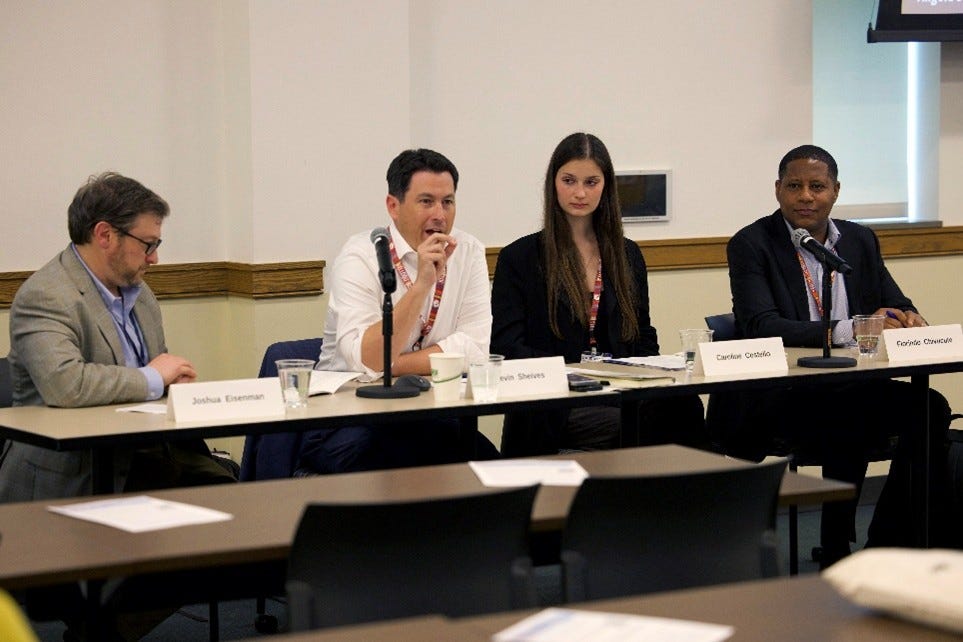
In our own panel discussion, Caroline, Florindo, and I, along with moderator Joshua Eisenman from Notre Dame, spoke about the new, more permissive international environment for the Chinese Communist Party and the Kremlin. We also discussed what “authoritarian influence at scale” looks like today, and how democratic actors might respond to this new dynamic. Throughout the process of developing Testing the Limits, I have been continually struck by the sophistication and comprehensiveness of China and Russia’s influence mechanisms. From AI-generated news and audio deepfakes attempting to sway the outcome of Moldovan elections to bribing officials and circumventing fair labor laws in Angola, these efforts have undermined democratic institutions and entrenched authoritarian practices. China and Russia’s strategies are increasingly sophisticated and have become far more ambitious than when the Forum began examining the phenomenon of “sharp power” more than a decade ago.
These questions aren’t just academic matters or topics for geopolitical discussions in Washington or Davos. Anti-democratic influence from Moscow and Beijing has acute impacts on the work of civil society and the lives of everyday citizens. Testing the Limits uncovers evidence that these impacts are metastasizing in new ways through advanced digital tools, economic leverage from China, and a more aggressive approach by Russia towards its neighbors—all enabled by an international environment of greater impunity.
The report has more to say about their strategies, and most critically, the contours of democratic responses to them. Stay tuned to the Forum and Democracy’s Horizons for more about this project.
The work of the conference presenters and many more across NED’s partner networks reminds us that in the face of persistent authoritarian challenges, democratic actors are actively and creatively advancing the cause of freedom in new ways. As the recent elections in Bolivia and Moldova show us, democracy can be restored and renewed through something as simple as the old-fashioned ballot box.
Kevin Sheives is the Director of the International Forum for Democratic Studies at the National Endowment for Democracy (NED). He previously worked for nearly fifteen years with the U.S. Department of State and three other government agencies.
The reality that the PRC and Russia are working non-stop to undermine democracy around the world tells us several things: 1) democratic institutions are the best way to thwart the dictators and all those who would undermine human rights; 2) democracy is primal in the prospect for human equality and authentic justice; and 3) democracy and rule of law matters.